
Please Choose Your Language
Follow
close
Choose Your Site
Global
Social Media


Views: 0 Author: Site Editor Publish Time: 2026-09-03 Origin: Site


Receiving defective or non-compliant kitchen equipment results in catastrophic downtime, expensive return freight, and safety liabilities. When a busy commercial kitchen halts operations due to failing gear, revenue immediately dries up while overhead costs multiply. For procurement managers and restaurant owners, verifying equipment before it leaves the factory represents the absolute final leverage point in the purchasing cycle. It is incredibly difficult to resolve engineering flaws or structural damage once a heavy appliance reaches your loading dock halfway across the world. Unchecked factory shipments often harbor hidden defects ranging from mismatched gas manifolds to inferior metal finishes. This guide provides a rigorous Factory Acceptance Testing (FAT) framework to evaluate equipment quality, compliance, and performance before authorizing final payment to your manufacturer. You will learn actionable protocols to systematically inspect every component, ensuring your newly manufactured units arrive perfectly calibrated and ready for seamless installation.
Procuring industrial cooking equipment demands substantial capital investment. The financial impact of receiving a defective food service commercial gas stove extends far beyond the initial purchase price. If a unit arrives with faulty valves or incorrect burner configurations, operators face immediate operational delays. You must absorb expensive return shipping costs, navigate complex warranty claims, and potentially delay a restaurant's grand opening. Catching these errors on the factory floor shifts the financial burden of rework entirely onto the manufacturer.
Mandatory pre-shipment inspections also serve as a powerful filtering mechanism. They naturally separate premium manufacturers who stand behind their craftsmanship from unreliable vendors who cut corners. When you inform a prospective factory that an independent auditor will evaluate the equipment prior to shipping, sub-par factories often decline the order. High-quality manufacturers welcome these audits because they already employ strict internal quality controls. This upfront transparency builds a foundation for a long-term, accountable partnership.
Many buyers make the mistake of accepting simple visual inspections. A factory might send a few photographs of a shiny, newly assembled commercial gas stove wrapped in plastic. However, checking for cosmetic shipping damage is entirely different from conducting a comprehensive functional audit. Visual checks confirm the item exists; functional checks confirm it works safely. A proper factory-floor audit requires testing the equipment under live gas pressure, measuring heat output, and verifying structural rigidity. You either dispatch a third-party Quality Assurance (QA) inspector to the facility or demand an unedited, continuous live video feed demonstrating specific performance metrics.
Kitchen environments are harsh, highly corrosive spaces filled with moisture, grease, and acidic food byproducts. Equipment longevity relies heavily on proper material selection. You must verify stainless steel grades directly on the factory floor. Many buyers specify premium SUS304 stainless steel for its superior corrosion resistance, but some factories discreetly substitute cheaper SUS201 steel to increase their margins. Inspectors use simple chemical testing drops to authenticate the metal. When applied to 304 stainless steel, the chemical remains clear or turns a specific color depending on the solution. If applied to 201 stainless steel, it quickly turns dark red, immediately revealing the substitution.
Structural integrity dictates how well the appliance will survive years of heavy daily use. Inspectors must examine seam welds across the entire chassis. Look closely for continuous, polished welds rather than cheap spot welds masquerading as heavy-duty construction. Spot welds create weak points and leave microscopic gaps where grease accumulates, eventually causing rust and sanitation failures. Furthermore, inspect the heavy-duty cast iron grates. They must sit perfectly flat without rocking. The main frame rigidity should withstand substantial weight without bowing or flexing under pressure.
Thoroughly validate the commercial gas stove specifications against your original CAD drawings or purchase order. Measure the overall width, depth, and height down to the millimeter. Even a slight variation can prevent the unit from fitting into a tightly designed kitchen line. Check the height of the backsplashes and the positioning of the adjustable bullet feet. Confirming these physical metrics guarantees the unit matches your spatial requirements perfectly.
If you ordered a custom commercial gas stove, verification becomes even more critical. Custom configurations often require highly specific burner placements, tailored wok ring sizing, and customized gas inlet positions to align with your exact kitchen layout. An inspector must cross-reference every custom modification against the approved engineering blueprint. If the factory placed the main gas inlet on the left side instead of the requested right side, fixing it at the factory takes hours. Fixing it at your restaurant requires hiring an expensive local gas plumber to re-pipe your entire wall.
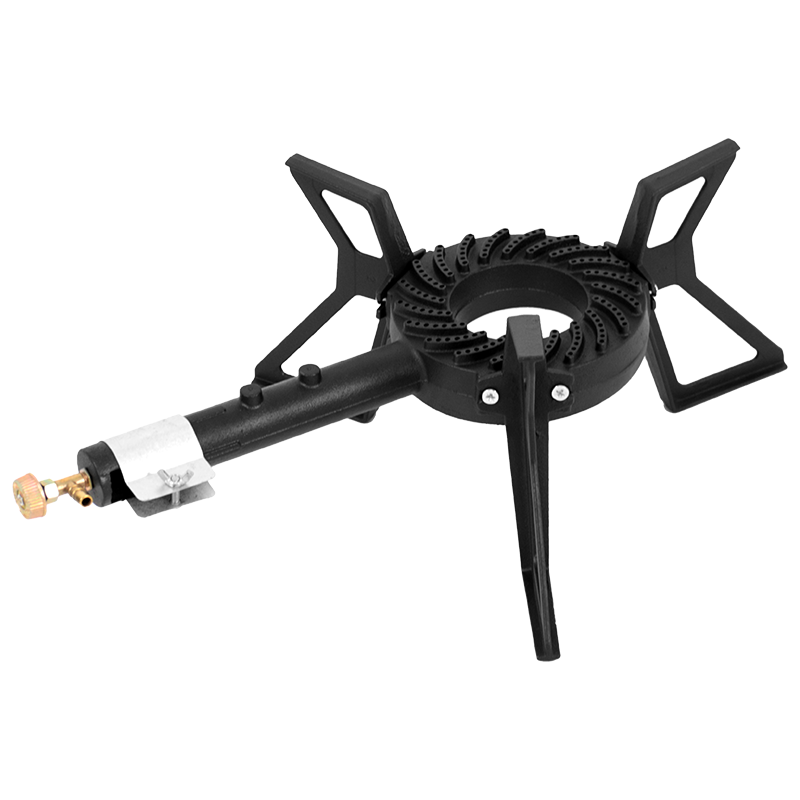
Physical appearance means nothing if the appliance fails to deliver consistent, safe heat. Performance testing at the factory level remains non-negotiable. Begin by ensuring the manufacturer demonstrates the equipment running at maximum capacity. Ignite every burner simultaneously to verify flame stability. You want to see a strong, crisp blue flame. If you observe yellow tipping or a floating flame, the air-to-gas ratio is incorrectly calibrated, or the burner rings possess manufacturing defects. Yellow flames produce dangerous levels of carbon monoxide and leave thick soot on cooking vessels.
Next, test the gas valve and knob precision. Brass valves control the lifeblood of the appliance. Turn every knob slowly from the lowest simmer setting to the maximum heat output. Evaluate the tactile feedback. The rotation must feel smooth and consistent. If a valve sticks, feels gritty, or exhibits loose play, it will likely fail within the first few months of high-volume use. Inconsistent valve responsiveness also frustrates chefs who rely on precise temperature control during busy service hours.
Automatic safety shut-off mechanisms protect kitchens from catastrophic explosions. You must rigorously evaluate the pilot light and thermocouple systems. The testing protocol requires the inspector to ignite the main burner and then intentionally extinguish the flame using a fan or compressed air while leaving the gas valve open. Monitor the thermocouple closely. Does the gas flow cut off instantly? Standard safety regulations require the thermocouple to detect the temperature drop and shut the main gas valve within seconds. If gas continues to hiss out of the extinguished burner, the safety mechanism is defective.
Finally, mandate strict pressure and leak detection procedures before the factory crates the equipment. Inspectors should apply a soap-bubble solution to all gas manifold joints, valves, and inlet connections while the system is pressurized. Any expanding bubbles indicate a dangerous gas leak. Advanced inspections utilize digital manometer readings to measure exact pressure drops over a specific time frame. This step guarantees the entire internal gas distribution system is completely sealed.
Customs officials and local utility inspectors strictly enforce compliance. Without the proper documentation and affixed labeling, your equipment may sit permanently impounded at the port. Start by checking the regulatory nameplates. Every compliant unit must feature a permanently affixed metal data plate. This plate must clearly detail the total BTU ratings, the specific gas type required (Natural Gas versus Liquid Propane), operating pressure, and a unique serial number. Inspectors look for stickers posing as metal plates; stickers peel off in hot environments and will fail local municipal inspections.
Different regions require entirely different safety marks. You must cross-reference visual proof of these required marks against the actual paper certificates provided by the factory. Check for CE marks if importing into Europe, CSA or ETL marks for North America, and ISI marks for specific Asian markets. The physical mark stamped on the machine must match the manufacturer's registered certification number. Counterfeit safety marks represent a massive liability; an independent auditor can verify the certification numbers directly with the issuing regulatory bodies.
Do not overlook the accompanying paperwork. Ensure your chosen commercial gas stove supplier has included all necessary user manuals and spares inside the crate. Manuals must provide English or localized installation guides, detailed maintenance procedures, and exploded parts diagrams. Furthermore, verify the inclusion of any requested spare parts. Kitchens often require extra conversion nozzles to switch fuel types, additional thermocouples, or spare control knobs. Discovering these small parts are missing after the crate arrives causes frustrating and unnecessary deployment delays.
Global Safety Certification Overview
| Certification Mark | Primary Region | Core Focus Area | Verification Method |
|---|---|---|---|
| CSA / ETL | North America | Gas safety, electrical compliance, emissions | Online directory cross-reference via serial number |
| CE | European Union | Health, safety, and environmental protection | Declaration of Conformity documentation check |
| ISI | India / South Asia | Material standards and domestic/commercial safety | Bureau of Indian Standards (BIS) portal verification |
| AGA | Australia | Gas appliance performance and leak prevention | Australian Gas Association database search |
Knowing what to inspect matters little if you do not know how to enforce the inspection. Buyers face a choice between hiring third-party QA agencies or relying on supplier-provided evidence. Hiring independent inspection agencies like SGS, TÜV, or reputable local equivalents offers the highest level of security. These professionals visit the factory, execute your exact checklist, and provide an unbiased, comprehensive report with hundreds of photos. If budgets do not allow for a physical inspector, you must demand an unedited, single-take factory video demonstration. The factory worker must film the continuous process of measuring the unit, conducting the chemical metal test, and lighting the burners without cutting the camera feed.
To successfully implement this strategy, you must establish the acceptance criteria long before manufacturing begins. Write specific inspection clauses directly into the initial Purchase Order (PO). If the PO lacks these clauses, the factory has no legal obligation to accommodate a third-party auditor. Outline the exact testing standards, the required metal grades, and the specific certifications required. State clearly that final payment remains contingent upon a passed inspection report.
Prepare protocols for handling defects when a stove fails the inspection. Establish clear rework timelines. If the auditor finds a leaking manifold or improper welds, stipulate how many days the factory has to correct the issue. Determine who bears the cost of the re-inspection; standard industry practice dictates that the factory pays for the second auditor visit if their equipment failed the first round. Maintain strict leverage by withholding final balance payments until the reworked unit passes all criteria flawlessly.
Relying on trust and handshakes is not a viable procurement strategy; systematic, evidence-based evaluation is the only way to protect your business. Pre-shipment inspections act as an insurance policy against poor manufacturing practices, ensuring you receive exactly what you paid for. By authenticating materials, testing performance metrics, and validating compliance data at the factory, you eliminate costly surprises upon delivery.
Your immediate next step is to finalize a definitive pre-shipment checklist tailored to your specific equipment needs. Share this checklist with your procurement team and communicate these non-negotiable inspection standards to your supplier before production concludes. Setting clear expectations early establishes a professional standard, ultimately delivering reliable, high-performing kitchen equipment to your culinary operations.
A: Yes, conversion is possible if the manufacturer designed the unit for dual-fuel capability. You must check that the correct conversion kits, specifically the orifices and nozzles, are included in the shipment if factory pre-configuration was not possible. A certified gas technician must perform the actual conversion on-site to ensure safe pressure regulation and proper flame calibration.
A: Yes. While the underlying design holds the certification, a pre-shipment inspection verifies the manufacturing execution of that specific unit. Factory lines can experience human error or tooling degradation. Inspections ensure no individual factory defects or assembly errors bypass quality control before local utility connections are made in your facility.
A: Standard manufacturing tolerances for commercial metalwork usually range from ±2mm to 5mm. You should reject a unit if the dimensional variation exceeds this threshold and prevents the appliance from fitting into a designated, pre-measured commercial kitchen line. Always communicate your required tolerances in the initial purchase order.
A: Standard export packing requires heavy-duty, fumigated wooden crates to comply with international shipping regulations. The interior should feature thick foam bracing to secure the unit and prevent shifting during transit. Finally, the equipment requires moisture barrier wrapping to prevent oxidation and rust caused by salty, humid ocean air after a successful inspection.

