
Please Choose Your Language
Follow
close
Choose Your Site
Global
Social Media


Views: 0 Author: Site Editor Publish Time: 2026-08-14 Origin: Site


Selecting a commercial kitchens high pressure gas stove is not just about maximizing raw heat output. It is about matching equipment design directly to your menu volume, operational safety standards, and commercial exhaust capacity. Operators often face real risks when they choose incorrect equipment sizes. If you under-spec your burners, you will suffer from slow thermal recovery times and bottlenecked service during peak hours. Over-speccing creates different headaches. It wastes valuable fuel and compromises your carefully balanced ventilation system. You need a clear path forward. This article provides foodservice operators and facility planners with an evidence-based framework. We will help you evaluate specific designs, assess crucial technical parameters, and properly vet vendors for your next upgrade. You will learn how to align intense culinary firepower with your physical facility constraints.
You must understand the fundamental differences between standard low-pressure commercial ranges and high-pressure systems. Standard ranges operate efficiently for basic simmering, sautéing, and general cooking. They usually run at low gas line pressures. High-pressure systems operate entirely differently. They use specialized regulators to push gas at much higher velocities. This creates an aggressive, highly focused flame. You do not need this power for every dish. However, certain culinary styles absolutely demand it.
We call this the "constant heat" requirement. Think about continuous wok cooking in a busy Asian fusion restaurant. A chef tosses ingredients rapidly in a carbon steel wok. The pan loses heat every time it leaves the burner. A standard range takes too long to recover this lost heat. The food steams instead of searing. A high pressure gas stove provides immediate thermal recovery. This instant heat ensures authentic flavor profiles, often called "wok hei." You also need high-pressure setups for rapid bulk liquid boiling. Boiling 40 gallons of stock takes hours on a standard burner. High-pressure burners cut this time dramatically.
You must also acknowledge the operational trade-offs. High-pressure cooking is not a magical fix for every kitchen. These systems consume significantly more fuel. They require larger gas lines and heavier exhaust hoods. Maintenance demands also increase. Intense heat polymerizes grease much faster. Food spills bake onto surfaces instantly. Jet burners clog if you do not clean them daily. You must commit to rigorous maintenance schedules to keep these powerful systems running safely.
Many buyers fixate solely on peak BTU (British Thermal Unit) ratings. This is a common mistake. High BTUs do not guarantee good cooking results. You must evaluate how the equipment transfers heat to your cookware. Burner ring design dictates heat distribution. Jet burners shoot flames vertically in a tight, aggressive column. They are perfect for round-bottom woks. Ring burners spread the flame wider. They suit large, flat-bottomed stockpots perfectly. If you pair the wrong burner style with your pans, you waste heat and damage your equipment.
Material integrity determines longevity. Commercial kitchens endure extreme physical abuse. Your stove frame must utilize heavy-gauge, fully welded stainless steel. Avoid riveted frames. They loosen over time under constant thermal expansion and contraction. We strongly recommend 14-gauge or 16-gauge stainless steel for maximum durability. Grates and burners also require careful evaluation. Cast iron grates hold heat beautifully and resist warping. However, they can rust if left damp. Brass components resist corrosion and withstand high heat excellently, but they often cost more upfront.
Control mechanisms require equal attention. Power means nothing if you cannot control it. Your chefs need precision. They must achieve peak roaring flames for searing, but they also need a reliable low simmer for delicate sauces. Cheap valves drift over time. They lose their calibration. You should demand heavy-duty, commercial-grade brass valves. When you review high pressure gas stove specifications, scrutinize the valve materials and burner styles closely.
Below is a quick reference comparing common burner and grate materials to guide your specification review:
| Component Material | Primary Advantage | Ideal Culinary Application | Maintenance Priority |
|---|---|---|---|
| Heavy-Duty Cast Iron | Exceptional heat retention and physical toughness. | Heavy stockpots and continuous high-heat searing. | Requires regular seasoning and dry storage to prevent rust. |
| Solid Brass Burners | High corrosion resistance and minimal thermal warping. | High-moisture environments and frequent liquid boils. | Needs periodic descaling to keep gas ports clear. |
| Welded Stainless Steel (14-Gauge) | Maximum structural rigidity against thermal shock. | High-volume commercial kitchens with heavy daily impacts. | Requires daily chemical degreasing to prevent pitting. |
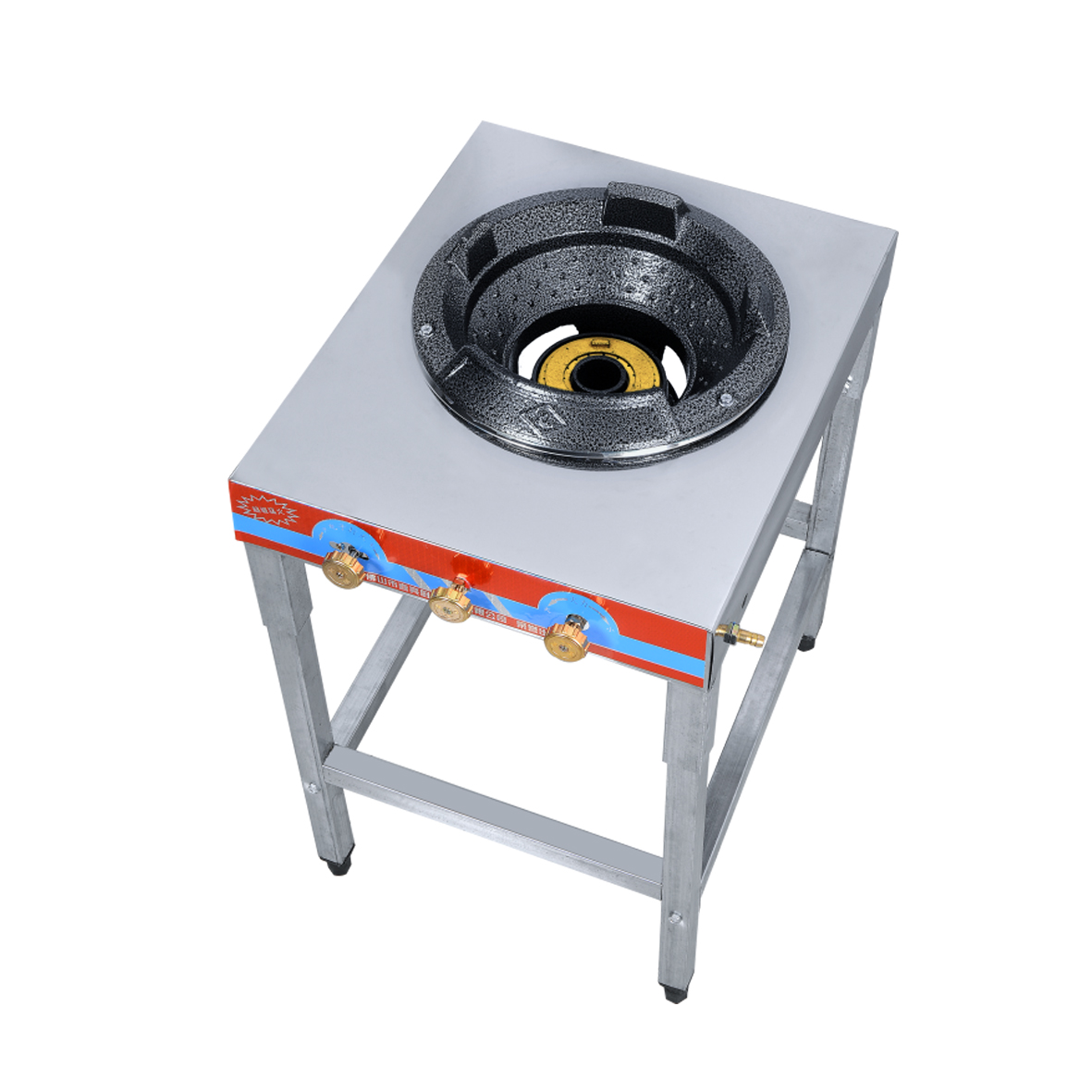
You can choose between off-the-shelf units and highly engineered specialty models. Standard heavy-duty ranges usually feature multi-burner configurations. They look like traditional ranges but pack much larger gas regulators. These units work best for steakhouses, diverse-menu diners, and standard catering prep kitchens. They offer versatility. You can boil pasta, sear steaks, and reduce sauces simultaneously on different burners.
Task-specific designs focus on single culinary functions. Standalone stockpot ranges sit much lower to the ground. This ergonomic design prevents chefs from lifting heavy, boiling pots to chest height. Commercial wok stations feature distinct engineering. They often include built-in water-cooling decks. Constant running water prevents the stainless steel top from buckling under the extreme heat of the jet burners. They also utilize knee-control valves. Chefs can adjust the flame intensity using their knees, keeping both hands free for tossing the wok and adding ingredients.
Sometimes, standard catalogs fall short. You might need to invest in a custom high pressure gas stove. This approach requires careful planning. Consider these specific triggers for customization:
Customization requires a longer lead time. The initial costs are also noticeably higher. However, you must weigh these factors against workflow efficiency. A custom unit reduces unnecessary kitchen movement. It speeds up service. It prevents chef fatigue. Over several years, this operational efficiency easily justifies the longer wait and higher upfront premium.
Upgrading your kitchen firepower introduces significant infrastructure risks. You cannot simply unbox a high-pressure unit, plug the gas line in, and start cooking. You must conduct a thorough infrastructure audit first. Check your existing commercial gas line diameter. A standard half-inch pipe cannot deliver enough volume for a multi-burner high-pressure system. You will starve the burners. The flames will sputter and die when you turn on multiple rings. You must also verify the inbound pressure, measured in PSI or water column (WC). Your local gas utility might need to upgrade your building's master regulator.
Ventilation realities catch many operators off guard. Heat output correlates directly with exhaust requirements. Higher BTUs dictate a higher CFM (Cubic Feet per Minute) exhaust capacity. If you double your stove's heat output, your existing hood might fail to capture the grease, smoke, and heat. The kitchen will become uncomfortably hot. Smoke will drift into the dining room. You must warn your project stakeholders about these hidden costs. Upgrading a stove frequently requires upgrading the HVAC system, exhaust fans, and makeup air units.
Safety devices serve as your final defense against disaster. High-pressure gas flow is inherently dangerous if unmanaged. Do not purchase any commercial stove lacking robust safety features. Thermocouples and flame failure devices are non-negotiable. If a strong draft blows out a burner flame, the thermocouple cools down immediately. It signals the valve to snap shut, cutting off the high-pressure gas flow. Without this device, raw gas fills the kitchen in seconds. Ensure pilot lights feature protective shrouds to prevent accidental extinguishment. Finally, verify all equipment compliance. Look for valid NSF, CE, or CSA certifications. Local fire marshals will shut down your kitchen if your equipment lacks proper safety ratings.
Finding the right equipment partner requires strict vetting. You must look beyond the initial quote. The B2B equipment market is full of aggressive salespeople pushing inferior products. Provide your purchasing team with a skeptical, evidence-based framework. Ask tough questions about structural integrity and long-term support. A low initial price often hides fragile components and terrible customer service.
Review the Service Level Agreements (SLAs) and warranties meticulously. A commercial warranty looks very different from a residential one. Read the fine print. Does the warranty cover parts and labor, or just parts? What are the expected response times? If your main wok station goes down on a Friday evening, you cannot wait until Tuesday for a technician. A solid high pressure gas stove supplier offers guaranteed emergency response times. They understand that downtime destroys restaurant profitability.
Parts availability determines equipment lifespan. High-pressure stoves endure brutal conditions. Consumable parts wear out. Jet tips clog and corrode. Control valves lose their seal. Pilot assemblies fail after thousands of heat cycles. You must ask suppliers about their spare parts inventory. Do they stock replacement parts domestically? Can they ship a new valve overnight? If a supplier relies on overseas shipping for basic replacement parts, walk away. You cannot afford to shut down a menu station for three weeks waiting for a small brass fitting. Choose a supplier who acts as a long-term operational partner, not just a transaction point.
The ideal high-pressure gas stove successfully balances required culinary firepower with your facility's physical and regulatory constraints. We have explored why specific menus demand intense heat recovery and how burner designs impact heat transfer. We also covered the critical differences between standard heavy-duty setups and highly customized kitchen lines. Finally, we highlighted the unavoidable infrastructure realities regarding gas pressure, exhaust hoods, and crucial safety compliance.
Your next step requires immediate action on the ground. Before you request a single quote, conduct a comprehensive site audit. Measure your gas line diameter and check your current inbound pressure. Verify your commercial hood's maximum CFM rating. Define your exact peak-hour thermal demands based on your menu. Once you gather this hard data, you can confidently approach shortlisted suppliers and build a kitchen designed for speed, safety, and success.
A: Yes, they are entirely safe when installed correctly. You must pair them with correctly sized, code-compliant commercial ventilation systems. They also require functioning flame-failure safety devices like thermocouples to prevent gas leaks if a flame blows out.
A: "Heavy-duty" refers to physical construction, like thicker steel frames and heavier cast iron grates. "High-pressure" refers specifically to the gas delivery system and regulator PSI. This pressure dictates the extreme velocity, shape, and intensity of the flame.
A: You must degrease stainless steel surfaces daily to prevent carbon baking. Wire-brush cast iron burners weekly to stop jet clogs. Finally, schedule bi-annual professional inspections for your high-pressure regulators, valves, and gas lines to ensure absolute safety.

