
Please Choose Your Language
Follow
close
Choose Your Site
Global
Social Media


Views: 0 Author: Site Editor Publish Time: 2026-09-10 Origin: Site


Acquiring premium commercial cooking equipment carries incredibly high stakes for any culinary business. Purchasing off-the-shelf units certainly saves procurement time initially. However, operators often face frustrating compromises regarding workflow layout, spatial design, or peak-volume performance. Standard models eventually reach a breaking point where they fail to meet harsh operational demands. You might suddenly encounter mismatched burner configurations, inadequate BTU output, or stringent local building codes. These physical limitations directly restrict culinary ambition and slow down daily service routines.
We present a clear decision framework below to help you evaluate your equipment needs. You will learn if the operational benefits justify the extended lead times and premium costs of custom builds. This guide empowers buyers to make smart, evidence-based appliance investments.
Understanding your baseline options serves as the first step in appliance procurement. Manufacturers build standard industry models to fit predictable, universal environments. You will typically find fixed widths measuring 30, 36, or 48 inches. These units feature standard open or sealed burner ratios and fixed oven capacities. They work perfectly for average restaurants operating under normal demand. However, pushing these standard units beyond their intended limits causes immediate service delays.
Buyers must identify specific triggers demanding equipment customization. Performance tuning often serves as the primary catalyst. Your menu might require variable BTU outputs across different zones. For example, chefs need dedicated wok rings for intense, rapid heating. Conversely, delicate sauces require precise low-simmer zones. Standard ranges rarely offer such extreme BTU variance on a single cooking surface.
Surface configurations represent another major customization trigger. Culinary teams frequently request swapping standard burners for integrated tools. You might need specialized griddles, charbroilers, or French tops to execute a specific menu. Matching the cooking surface to your exact culinary output eliminates unnecessary pan movements. It streamlines the entire brigade workflow.
Material upgrades and local compliance also force buyers toward custom builds. Harsh environments quickly degrade standard appliance metals. Upgrading to heavy-gauge 304 stainless steel extends appliance longevity significantly. Additionally, you may need modified gas inlets to satisfy strict regional safety regulations. Standard models might fail local inspector reviews if inlet placements conflict with existing kitchen infrastructure.
You must weigh the upfront engineering costs carefully. A custom build requires significant initial investment. However, you gain long-term labor efficiency through a tailored cooking surface. Your kitchen staff will work faster and safer. You reduce wasted movement, improve ticket times, and maximize daily output.
| Feature Category | Standard Models | Custom Models |
|---|---|---|
| Size and Dimensions | Fixed widths (30", 36", 48", 60") | Built to exact millimeter specifications |
| Burner Configuration | Uniform BTU output across all burners | Variable BTU (wok rings, simmer zones) |
| Surface Elements | Predominantly open or sealed burners | Integrated griddles, French tops, broilers |
| Material Grade | Standard commercial stainless steel | Heavy-gauge 304 or 316 marine-grade steel |
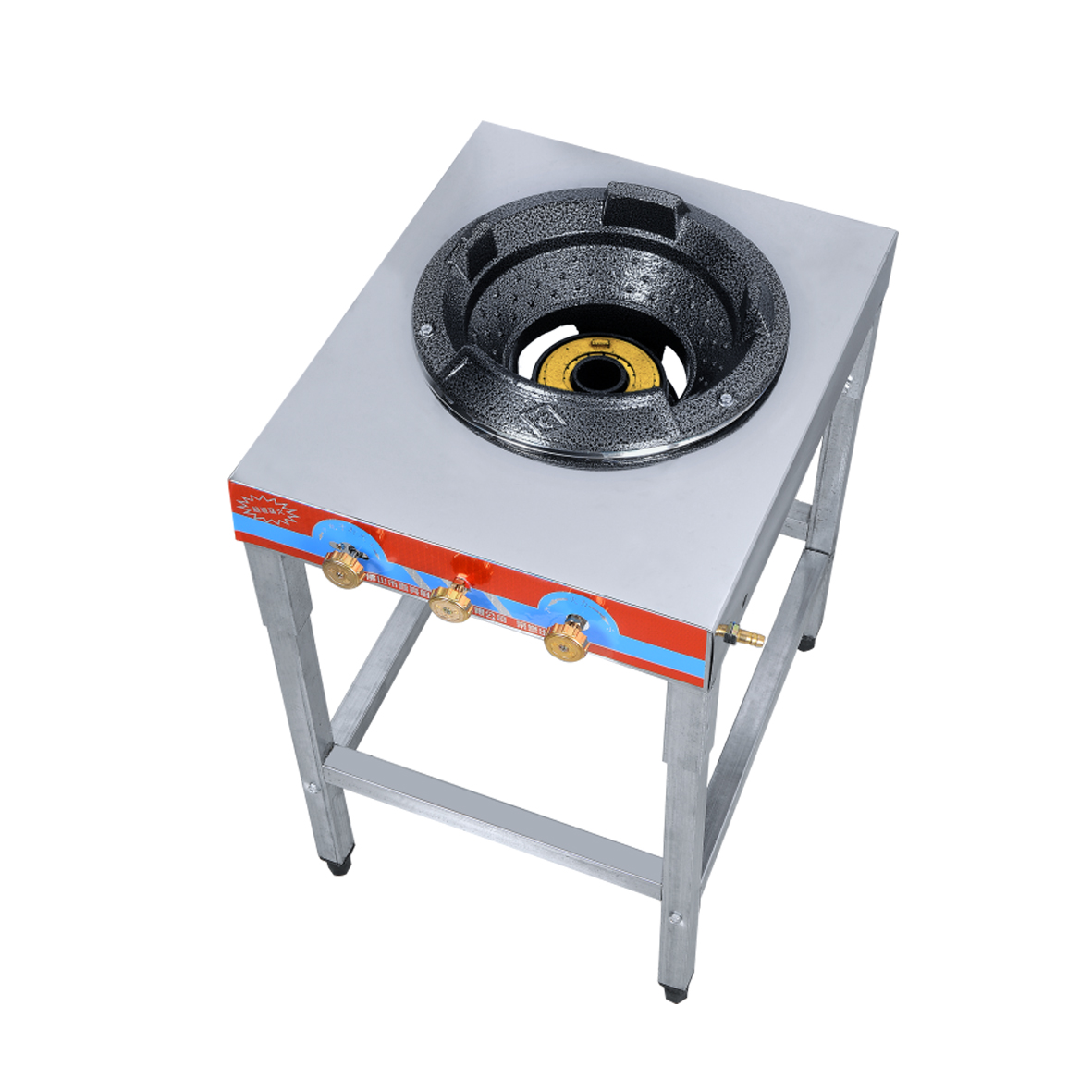
Massive culinary operations require specialized tools to survive daily service. A hotel kitchens free standing gas range deployment rarely relies on pure off-the-shelf models. These environments demand simultaneous multi-menu preparation. Teams operate 24 hours a day, seven days a week. Standard ranges simply lack the architectural stamina for continuous, non-stop operation.
Operational scaling forces executive chefs to rethink their equipment strategy. A hotel services banquets, room service, and fine dining simultaneously. You cannot manage this complexity using a basic six-burner stove. Custom ranges allow chefs to physically map the appliance to their specific brigade system. You can design plating zones directly adjacent to high-heat searing zones. This physical alignment reduces staff collision and speeds up dish assembly.
Durability becomes non-negotiable in these high-volume settings. Custom builds incorporate structural reinforcements absent in standard models. You will need reinforced grates capable of holding massive stockpots. Custom-fitted drip pans make mid-shift cleaning faster and safer. Modular internal components are equally vital. Modularity allows technicians to perform rapid maintenance on a single faulty burner. They can fix the issue without shutting down the entire cooking line.
Purchasing a custom cooking unit solves many culinary problems. However, it introduces significant facility challenges. Expanding appliance dimensions drastically alters your existing infrastructure requirements. Buyers frequently overlook the cascading effect of upgrading a free standing gas range. You must coordinate carefully with facility managers and specialized contractors.
The ventilation mismatch represents a massive buyer blind spot. Contractor forums constantly discuss this exact failure. Upgrading from a standard 36-inch size to a custom 54-inch width requires exponential exhaust upgrades. You must expand the overhead hood capture area proportionally. Furthermore, your Make-Up Air (MUA) systems must handle the increased exhaust volume. Failing to upgrade ventilation leads to immediate health code violations and a smoke-filled kitchen.
Clearance and gas line logistics require meticulous planning. A custom unit demands exact installation parameters. You must respect minimum combustible clearances outlined by fire safety standards. Customized gas inlet positioning might require rerouting your facility's main gas lines. Additionally, custom builds often utilize heavier metal alloys. You must verify floor reinforcement to support these heavier, modified units safely.
Installation phasing presents unique logistical realities. You cannot simply roll an oversized custom range through a standard commercial doorway. Teams must plan the physical delivery route weeks in advance.
Tailored equipment delivers exceptional culinary advantages. However, buyers must acknowledge the inherent risks tied to bespoke manufacturing. A custom free standing gas range introduces variables absent in standardized purchasing. Ignoring these risks can derail new restaurant builds or paralyze kitchen renovation launches.
Lead times represent the most immediate hurdle. Custom fabrication extends procurement timelines significantly. Standard units often ship within days from a warehouse. Conversely, bespoke models require engineering drafts, client approvals, and specialized manufacturing runs. Material shortages can further delay custom fabrication. You must factor these extended timelines into your overarching project schedule to avoid opening delays.
Parts and servicing present long-term operational threats. A standard range utilizes universal replacement parts. Local technicians usually stock these standard valves, thermocouples, and burners in their vans. Custom modules, however, may require highly proprietary parts. If a bespoke burner fails, you might have to order replacements directly from the factory. This scenario risks unacceptable operational downtime while waiting for shipping.
Resale value and standardization pose financial challenges. Businesses evolve, menus change, and physical layouts adapt over time. Highly specific custom units are notoriously difficult to liquidate. Another restaurant owner likely will not want your highly specific layout. If your business model pivots, repurposing a bespoke range proves incredibly challenging.
Executing a custom build requires a sophisticated manufacturing partner. You cannot rely on a standard equipment reseller for bespoke designs. Vetting your manufacturing partner protects your investment and ensures safety compliance. You must evaluate their engineering resources, component sourcing, and aftermarket support structures.
Engineering expertise stands as the primary vetting criterion. The supplier must provide detailed Computer-Aided Design (CAD) drawings before starting fabrication. They must supply comprehensive technical specification sheets. These documents allow your local inspectors to verify alignment with fire and building codes. If a supplier refuses to provide detailed pre-fabrication schematics, walk away immediately.
Component transparency dictates the long-term reliability of your unit. Instruct buyers to verify internal parts. Ask if the manufacturer uses proprietary valves and burners. Ideally, they should use easily sourced, industry-standard internal components housed within their custom external shells. This hybrid approach gives you the perfect physical layout without sacrificing serviceability.
An ironclad After-Sales Service Level Agreement (SLA) is mandatory. Define the required warranty structures for all custom additions. Standard warranties often exclude bespoke modifications. You must emphasize guaranteed response times in the contract. Ensure they maintain a robust, localized technician network capable of servicing their specific custom builds.
| Evaluation Area | What to Demand | Red Flags to Avoid |
|---|---|---|
| Engineering Proof | Full CAD schematics and BTU load calculations | Hand-drawn sketches or refusal to share specs |
| Parts Sourcing | Universal, easily accessible internal valves | 100% proprietary internal components |
| Compliance | NSF/ANSI, UL, or CE certification on final build | Claims that local inspectors "won't mind" |
| Support SLA | Written response times and custom part warranties | Vague promises about post-installation help |
Deciding to customize commercial cooking equipment requires rigorous operational analysis. A free-standing unit should only undergo customization when standard specifications actively hinder your daily output, compromise safety, or fail exact spatial requirements. Standard units remain highly effective for traditional layouts. However, bespoke models unlock unparalleled efficiency in high-volume, specialized culinary environments.
Your next steps involve careful internal auditing. Map your current menu bottlenecks to see if appliance layout causes service delays. Measure your maximum overhead hood capacity to understand your physical expansion limits. Finally, reach out to specialized manufacturers. Request a deep technical consultation rather than a basic price quote. This meticulous approach guarantees you invest in equipment that genuinely elevates your kitchen's performance.
A: Custom models typically cost 20% to 50% more than their standard counterparts. You are paying for upfront engineering, specialized fabrication, and low-volume material sourcing. Complex modular additions, like integrated French tops or customized heavy-gauge steel, drive this percentage higher rather than a flat dollar amount.
A: Yes, it strongly impacts compliance. Reputable suppliers ensure the custom build retains core UL, CE, or NSF/ANSI certifications. However, acquiring local inspector approval remains the buyer's ultimate responsibility. Modifying range dimensions or BTU outputs drastically alters your required ventilation and fire suppression requirements.
A: You should expect a realistic benchmark of 8 to 16 weeks from design approval to delivery. Material availability, engineering drafts, and client design iterations heavily influence this timeline. Always pad your construction or renovation schedule to accommodate potential bespoke manufacturing delays.

