
Please Choose Your Language
Follow
close
Choose Your Site
Global
Social Media


Views: 0 Author: Site Editor Publish Time: 2026-07-31 Origin: Site


Upgrading to a 5-burner gas hob introduces complex considerations around counter space, heat distribution, and gas line capacity. Many home chefs mistakenly buy units based solely on visual appeal rather than functional capability. This often leads to frustrating installation delays or cramped cooking areas where pots constantly collide. A successful purchase aligns technical specifications directly to your cooking workflow. You can achieve professional-level heat control without requiring a complete countertop reconstruction. Evaluating a new cooktop means looking far beyond the polished surface. You must analyze specific functional metrics and strict installation constraints before committing to a model. In this guide, we break down exactly what you need to measure and verify before purchasing. You will learn how to balance heat output requirements for various dishes. We also explain how to choose burner materials built for long-term durability. By the end, you will fully understand essential safety standards and commercial sourcing strategies.
Buyers frequently confuse overall surface dimensions with cutout dimensions. This simple misunderstanding serves as a major implementation risk during kitchen renovations. The overall footprint refers to the visible glass or steel surface resting on top of your counter. The cutout dimension refers to the hole required in your cabinetry to drop the chassis inside. If you purchase a unit with a chassis larger than your existing hole, you face expensive countertop modifications. Cutting into existing granite or quartz requires specialized tools, creates massive dust, and heavily disrupts your home.
You must rigorously measure your current countertop opening before browsing models. Standard 5-burner units typically demand a surface width ranging between 75cm (30 inches) and 90cm (36 inches). However, the internal cutout widths vary significantly between manufacturers. Typical cutout depths run between 19 and 20 inches. Securing a perfectly sized 5 burner gas hob ensures a drop-in fit, saving you hours of contractor labor.
Clearance and ventilation represent another critical spatial requirement. Fire safety codes strictly govern the vertical distance between gas flames and combustible materials above them. Most building codes mandate a minimum vertical clearance of 30 to 36 inches between the cooktop surface and the range hood or unprotected cabinetry. You also need adequate lower clearance below the hob chassis. The bottom of the unit often requires several inches of breathing room above under-counter ovens or storage drawers to prevent heat buildup.
You should also evaluate the actual usable space between the burners. Adding a fifth burner sounds appealing, but poor spacing renders it useless. A poorly designed layout crowds pots together. We recommend checking the center-to-center distance between adjacent burners. You need a minimum spacing of 10 to 11 inches between burner centers to comfortably use multiple 12-inch skillets simultaneously. If the burners sit too close together, large pans will push each other off the heat center, ruining your heat distribution.
Evaluating heat output requires breaking down performance by specific cooking scenarios rather than just looking at the total combined output. Manufacturers heavily market their total British Thermal Units (BTUs) or Kilowatt (Kw) ratings. However, an impressive total number does not guarantee a good cooking experience. You need the right amount of heat delivered to the right specific pan. Reviewing detailed 5 burner gas hob specifications helps you match the burner configuration directly to your culinary habits.
The central wok burner usually anchors a 5-burner layout. This acts as your baseline for high-heat cooking tasks like stir-frying, deep-frying, and searing heavy meats. Look for dual-ring or triple-ring brass burners here. Multiple rings spread the intense flames across the wide bottom of a wok or large stockpot. A high-performance central burner should deliver between 15,000 and 20,000 BTUs. Anything lower will struggle to recover heat quickly when you drop cold ingredients into a hot pan.
While massive heat commands attention, simmering capabilities remain equally important. Dedicated auxiliary burners handle delicate culinary tasks. You need at least one low-BTU burner specifically calibrated for simmering. An ideal simmer burner drops down to a range of 3,000 to 5,000 BTUs. This low threshold allows you to melt chocolate, hold delicate sauces, or braise tough cuts of meat for hours without scorching the bottom of your pot.
Layout practicality determines how efficiently you move around the stove. Most manufacturers place the highest heat burner directly in the center. This strategic placement keeps heavy, boiling pots highly stable in the middle of the appliance. It also keeps extreme heat away from your body and protects adjacent wooden cabinets from heat damage. Placing the medium-heat burners on the front left and right allows you to handle everyday sautéing comfortably. The low-heat simmer burner often sits in the back, keeping delicate sauces out of your primary working zone.
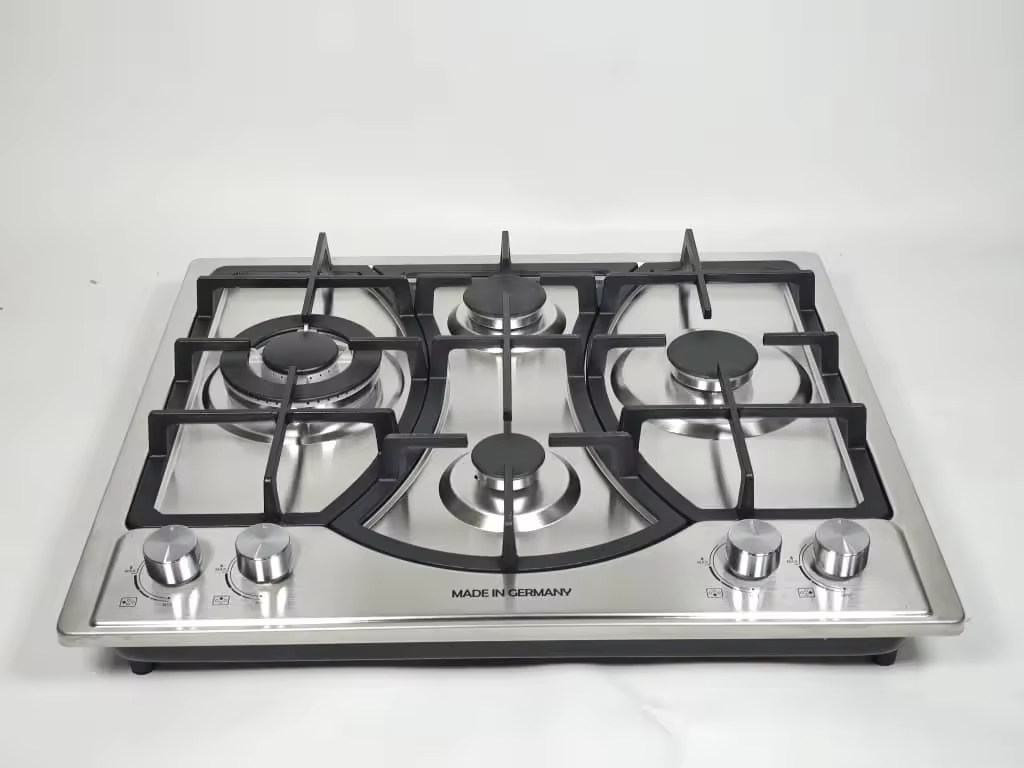
The physical construction of your cooktop dictates its lifespan and daily maintenance requirements. We evaluate three primary surface materials in the modern appliance market. Stainless steel offers a highly durable, commercial-grade finish. It resists thermal shock beautifully but remains prone to micro-scratching and readily shows fingerprints. Tempered glass provides an ultra-modern aesthetic and wipes clean effortlessly. However, glass remains susceptible to shattering under extreme impact from dropped cast iron pans. Enamel surfaces offer a cost-effective, traditional look but can chip or craze over years of heavy use.
| Surface Material | Primary Advantage | Primary Drawback | Best Suited For |
|---|---|---|---|
| Stainless Steel | High thermal tolerance | Shows scratches easily | High-volume or commercial cooking |
| Tempered Glass | Effortless cleaning | Shatter risk from impact | Modern residential kitchens |
| Enamel Coating | Traditional aesthetics | Prone to chipping | Budget-conscious renovations |
Grate and pan supports separate premium cooktops from entry-level models. We strongly argue for continuous, heavy-duty cast iron grates over standard enameled steel options. Steel grates warp under intense heat and feel flimsy under heavy pots. Continuous cast iron grates interlock across the entire surface. This flat, unified grid allows users to slide heavy stockpots from a front high-heat burner to a rear simmer burner without lifting them. This simple design feature drastically reduces wrist strain and prevents accidental spills.
Burner caps and internal valves require equally durable materials. We always recommend solid brass components over die-cast aluminum. Brass possesses superior heat tolerance. Aluminum burner caps tend to warp, discolor, or melt slightly over years of heavy daily use. Warped caps disrupt the gas flow, leading to uneven flames and inefficient burning. Brass valves also maintain tighter seals over time, ensuring your control knobs remain smooth and responsive after thousands of turns.
Modern gas appliances must integrate advanced safety systems to protect users from accidental gas leaks. The Flame Failure Device (FFD) stands as the most critical safety feature. This mandatory compliance feature utilizes simple but highly effective thermocouple technology. A thermocouple sensor sits directly next to the burner ring. When you ignite the burner, the flame heats the sensor, generating a tiny electrical current. This current signals the gas valve to remain open. If wind or a boiling liquid spills over and extinguishes the flame, the sensor rapidly cools down. The electrical current stops, and the valve instantly snaps shut, cutting off the gas supply. You should never purchase a cooktop lacking an FFD system.
Ignition types also dictate installation requirements. Modern hobs feature auto-ignition mechanisms integrated directly into the control knobs. Pushing and turning the knob simultaneously releases the gas and triggers the electronic spark. Older or cheaper models might rely on a secondary, manual ignition button you press while turning the knob. Auto-ignition requires electrical power. You must check the electrical requirements carefully. Most units require a standard 110V or 220V wall plug located under the cabinet. If you lack under-counter outlets, look for specific models operating entirely on replaceable D-cell batteries.
You must carefully verify gas type compatibility before completing your purchase. Homes typically utilize either municipal Natural Gas (NG) lines or standalone Liquid Petroleum Gas (LPG) propane tanks. Hobs come pre-configured from the factory for one specific gas type. Pushing NG through an LPG-configured burner results in massive, dangerous yellow flames. Ensure your chosen model includes a certified conversion kit. These kits contain replacement brass orifices (nozzles) designed to regulate the different pressure levels of propane versus natural gas.
High-volume cooking environments demand entirely different specifications than casual residential kitchens. A restaurant kitchens 5 burner gas hob faces relentless daily abuse. These units require significantly thicker gauge stainless steel bodies to withstand heavy impacts. Commercial models must support higher continuous BTU ratings across all five burners simultaneously without overheating the internal manifold. Furthermore, commercial environments demand strictly mechanical control knobs. The high ambient heat of a busy restaurant kitchen quickly melts or distorts standard residential plastic knobs.
Standard retail models sometimes fail to accommodate unique culinary workflows. In these scenarios, sourcing a custom 5 burner gas hob becomes necessary. Custom configurations allow chefs to integrate specific cooking tools directly into the chassis. You might request a sunken wok ring for better ergonomic tossing or add a flat teppanyaki plate over two of the auxiliary burners. Custom manufacturers can also fabricate non-standard cutout sizes, allowing you to seamlessly replace outdated legacy appliances without modifying your expensive commercial prep tables.
Finding a reliable manufacturing partner heavily influences long-term operational success. When evaluating a 5 burner gas hob supplier, prioritize post-purchase support over upfront pricing. Look for suppliers offering robust warranties spanning a minimum of 2 to 5 years. Ask about their replacement parts inventory. A great supplier ships replacement thermocouples, brass caps, and ignition modules within 48 hours. For commercial buyers or regional distributors, verify the supplier's OEM (Original Equipment Manufacturer) and ODM (Original Design Manufacturer) capabilities. These capabilities ensure the factory can scale production and customize branding to match your specific fleet requirements.
Purchasing the right cooktop requires a systematic evaluation framework. You must prioritize cutout compatibility first. Measuring your exact cabinet dimensions prevents disastrous installation delays and costly countertop modifications. Second, analyze the BTU distribution. Ensure the central burner provides enough intense heat for your wok, while auxiliary burners drop low enough for delicate simmering. Finally, select a material finish matching your cleaning habits and visual preferences, leaning toward cast iron and brass for maximum longevity.
Your next step requires immediate action in your kitchen. Grab a tape measure and document your current cutout width, depth, and vertical clearance. Next, check your utility bills or external tanks to confirm whether you utilize Natural Gas or LPG. Armed with these exact numbers and facts, you can confidently browse supplier catalogs or contact commercial manufacturers to find a unit matching your exact culinary demands.
A: It depends on space and cooking habits. A 5-burner offers dedicated wok cooking and handles more dishes simultaneously, but requires a wider 30"+ space to avoid pot crowding. If your counter space is limited, a well-spaced 4-burner might prove more practical than a cramped 5-burner setup.
A: Typically, a minimum cabinet width of 30 inches (76 cm) is required, though 36 inches (90 cm) offers better practical spacing for large cookware. You also need standard clearances of at least 30 inches above the cooking surface to meet fire safety codes.
A: Yes, most reputable models include an LPG conversion kit, but this requires swapping the burner orifices and adjusting the regulator, which should be done by a certified professional. Operating the hob on the wrong gas type poses severe fire hazards.
A: Yes, because of the higher combined BTU output, a range hood with an extraction rate matching the total BTUs (typically 400-600+ CFM) is strongly recommended to handle excess heat and grease. Commercial setups may require even higher extraction capacities.

