
Please Choose Your Language
Follow
close
Choose Your Site
Global
Social Media


Views: 0 Author: Site Editor Publish Time: 2026-08-27 Origin: Site


Sourcing kitchen equipment goes beyond sleek looks. In commercial kitchens, aesthetic finishes matter less than thermal tolerance, corrosion resistance, and structural integrity. Every component takes a severe beating during busy service hours. A standard commercial stove must withstand continuous high-BTU output and extreme temperature shifts. You also expect it to survive daily chemical cleaning without rusting or breaking down. Buying poorly built equipment often leads to sudden failures and severe safety hazards. This guide exists to help you make smarter purchasing decisions. We provide procurement managers and restaurant owners with a strict, material-based evaluation framework. You will learn exactly what to look for when reviewing technical sheets. We show you how to avoid overpaying for unnecessary specs or under-buying on critical components. Your kitchen relies on durable, compliant tools to succeed.
Kitchen managers must scrutinize exterior construction first. The base chassis holds everything together. Poor metal choices lead to premature equipment failure.
Not all stainless steel performs equally. We look specifically at chromium and nickel composition. Grade 304 contains roughly 18% chromium and 8% nickel. This mixture creates an incredibly durable, non-magnetic surface. It resists rust aggressively. It also fights off acidic degradation. Spilled tomato sauces and strong vinegars will not pit a 304 stainless surface.
Many cheaper units use grade 430 stainless steel. Grade 430 contains almost no nickel. You can easily identify it because magnets stick to it. Without nickel, the metal loses essential corrosion resistance. Daily exposure to moisture and sanitizing chemicals ruins 430 steel. Over time, it rusts and degrades. Grade 304 remains the strict industry standard for serious culinary operations.
Metal gauge determines structural integrity. The gauge number refers to the thickness of the sheet metal. Lower numbers indicate thicker steel. Commercial settings require heavy-duty load-bearing frameworks. A thin chassis will buckle. You often place massive stockpots on the grates. The underlying steel must support this weight without warping.
We strongly recommend 16-gauge or 14-gauge steel for the main body. 16-gauge measures about 0.0598 inches thick. 14-gauge measures roughly 0.0747 inches thick. Thinner metals, like 20-gauge, bend under pressure. Bent chassis misalign gas lines and create dangerous cooking environments.
Metal Gauge Thickness Comparison
| Gauge Standard | Approximate Thickness (Inches) | Commercial Suitability | Primary Application |
|---|---|---|---|
| 14-Gauge | 0.0747" | Excellent | Heavy structural frames, load-bearing legs |
| 16-Gauge | 0.0598" | Standard / Good | Main chassis, side panels, standard griddles |
| 18-Gauge | 0.0478" | Marginal | Light duty panels, non-structural covers |
| 20-Gauge | 0.0359" | Poor | Avoid for high-volume commercial ranges |
Construction methods impact hygiene directly. Manufacturers assemble frames using either welds or rivets. Seamlessly welded steel eliminates gaps. Smooth surfaces prevent grease trapping. Food particles cannot hide in welded seams.
Riveted construction introduces tiny crevices everywhere. Liquid grease seeps into these joints. Bacteria breed rapidly in these hidden spots. Line cooks cannot clean them out effectively. Health inspectors actively look for grease buildup in seams. Failing an inspection hurts business reputations. Welded construction ensures better health inspection outcomes.
Heat generation relies entirely on burner materials. Burners endure constant thermal shock. They heat up rapidly and cool down daily. Material selection dictates their lifespan.
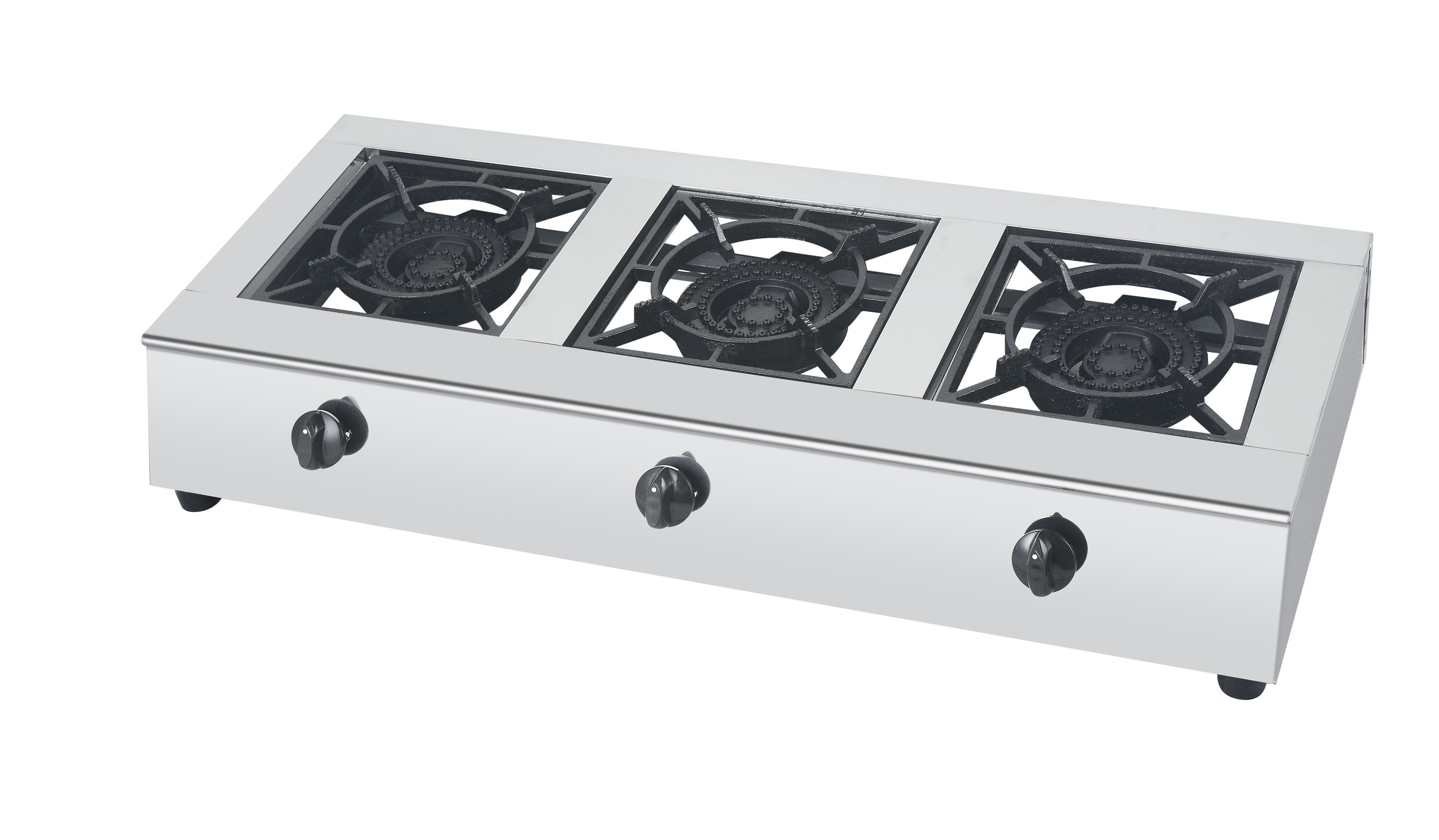
Grates take the most physical abuse. Pans slam onto them constantly. Cooks drag heavy pots across the surface. Continuous cast-iron grates are completely non-negotiable. They allow cooks to slide heavy pans seamlessly across the cooking surface. Lifting a 40-pound stockpot causes severe back strain. Sliding prevents ergonomic injuries.
Cast iron provides the perfect amount of friction. Pans stay stable during vigorous sautéing. Enamel-coated cast iron offers an added benefit. The coating creates a smoother surface. This makes daily sanitization much easier. It also protects the underlying iron from moisture. Safety and efficiency improve dramatically when you specify continuous, heavy-duty grates.
Purchasing decisions must align with operational volume. You cannot evaluate materials in a vacuum. The power output dictates the required material strength.
Burner power directly impacts structural integrity. Higher BTU ratings demand higher-grade burner materials. Intense heat stresses metals constantly. A single burner producing 40,000 BTUs creates massive thermal expansion. If you combine three such burners, the overall thermal load becomes massive.
You must align performance metrics properly. Buying a 120,000 BTU unit requires thick-gauge burners. Pairing massive BTUs with thin aluminum burners leads to rapid equipment failure. The metals simply melt or warp. Warped burners leak raw gas. Leaking gas creates severe explosion hazards. Always verify the burner composition before approving high-BTU specifications.
Space constraints force specific design choices. A compact restaurants 3 burner commercial gas stove operates differently than a massive range. Smaller kitchens suffer from poor ambient airflow. Equipment sits packed closely together.
Compact ranges require maximized thermal efficiency. The unit must direct heat upward into the pan. It cannot radiate excessive heat outward. Localized heat shielding becomes critical here. These shields protect adjacent under-counter refrigeration units. They also prevent stainless prep tables from becoming dangerously hot. Premium internal insulation keeps the exterior chassis cool. This prevents adjacent compressors from overworking and failing.
Standard catalog models work for most operations. Sometimes, unique kitchens demand tailored solutions. Customizing equipment solves complex physical constraints.
Custom builds solve distinct operational problems. Standard dimensions often fail in older buildings. Legacy kitchens might have restrictive wall layouts. Fire suppression hoods might sit lower than modern standards dictate. In these scenarios, modifying the chassis depth or height saves the entire kitchen design. The return on investment justifies the upfront design costs.
Modifications usually involve material upgrades. You can specify exact metals based on your menu.
Customization introduces distinct trade-offs. You must anticipate much longer lead times. Manufacturers need time to retool their production lines. Supply chains for specialized metals fluctuate constantly. You also face rigorous compliance risks. Every custom modification needs strict specification sign-offs. Local inspectors will scrutinize custom equipment closely. You must ensure the final product meets all commercial fire codes. Work closely with an engineer to guarantee safety compliance.
You cannot trust marketing brochures alone. Reliable procurement requires aggressive supplier auditing. You must verify every claim before releasing funds.
Always audit your vendor thoroughly. Demand absolute transparency regarding materials. Ask for certified material data sheets. These sheets verify the exact grade of steel used in the chassis. They also confirm the exact burner composition. If a vendor hesitates to provide documentation, walk away immediately. Reputable manufacturers proudly share their metallurgical data. They know quality materials justify their pricing.
Safety approvals remain strictly non-negotiable. Kitchen fires destroy businesses and cost lives. Highlight the absolute necessity of standard commercial approvals. Look for NSF marks. NSF certification guarantees the materials meet food-grade sanitation standards. Check for CSA or CE badges depending on your region. These certifications prove the equipment meets rigorous fire-safety standards. Inspectors will red-tag uncertified equipment. Red tags shut down your kitchen immediately.
Read the fine print meticulously. Warranties often contain hidden traps. Advise buyers to check clauses regarding "rust" or "corrosion". Cheap suppliers frequently void warranties quickly. They claim you used "improper cleaning methods." In reality, they used low-grade steel. Standard commercial cleaning chemicals easily ruin cheap metals. A strong warranty covers structural integrity without ridiculous cleaning restrictions. Protect your investment by understanding exactly what the warranty excludes.
Smart procurement relies on objective material science. You must prioritize the right components. Always demand a 304 stainless steel chassis. This grade ensures long-term rust resistance and sanitary compliance. Specify cast iron or forged brass burners to handle continuous thermal shock. Verify the exact gauge thickness. Look for 14-gauge or 16-gauge steel to prevent dangerous chassis warping under heavy loads.
Take action by standardizing your purchasing process. Draft a standardized Request for Proposal (RFP) for your next equipment upgrade. Emphasize these exact material requirements in your RFP document. This strategy instantly filters out sub-par manufacturers. It forces vendors to compete on actual quality rather than vague marketing claims. Protecting your kitchen infrastructure starts with demanding better materials.
A: Many buyers use the "magnet test." A magnet will stick to 430 stainless steel, but it will not stick to high-quality 304 stainless. However, this test has limitations. Certain manufacturing processes can make 304 slightly magnetic. Always rely on certified manufacturer specification sheets for absolute confirmation.
A: Brass resists heat deformation better and never rusts. It requires significantly less daily maintenance. Cast iron provides superior heat retention and distribution. However, cast iron demands daily seasoning and strict cleaning protocols to prevent rust. Brass costs more upfront but saves labor long-term.
A: Sealed burner designs eliminate internal grease traps entirely. For grates, enamel-coated cast iron offers the easiest cleaning experience. The enamel provides a smooth, non-porous surface. You can wipe away carbonized food rapidly without damaging the underlying iron framework.
A: Quality continuous cast-iron grates typically last 5 to 7 years under heavy daily use. Lifespan depends primarily on metal fatigue and thermal shock. Dropping cold heavy pots onto red-hot grates causes micro-fractures. Avoiding extreme temperature shocks extends grate longevity significantly.

