
Please Choose Your Language
Follow
close
Choose Your Site
Global
Social Media


Views: 0 Author: Site Editor Publish Time: 2026-09-17 Origin: Site


Sourcing cooking appliances at scale amplifies both margins and risks. A misjudged bulk order of gas hobs can lead to compliance failures, high defect rates, and lasting brand damage. Evaluating a stainless steel gas hob for wholesale distribution or commercial outfitting requires deep scrutiny. You must move past glossy B2C features. Buyers need to examine manufacturing tolerances, material grades, and localized safety certifications closely. We provide procurement teams, distributors, and commercial outfitters with a standardized evaluation framework. You will learn how to vet specifications, verify supplier claims, and minimize post-purchase maintenance liabilities. Let us explore how to secure a reliable bulk investment and build a resilient product portfolio.
You must establish baseline technical standards to separate durable products from low-cost, high-risk alternatives. Evaluating materials and internal components prevents costly failures in the field. Procurement teams often look at surface finishes. They should focus on structural integrity instead. We recommend building a rigid technical framework for every wholesale purchase. Evaluating stainless steel gas hob specifications requires a close look at metallurgy, burner efficiency, and safety mechanisms.
The chassis material dictates the lifespan of the appliance. You will typically encounter three grades of steel. Grade 304 offers high corrosion resistance. It contains higher nickel content. We consider it essential for catering environments exposed to moisture and salt. Grade 201 and 430 are cost-effective alternatives. However, they remain highly prone to rusting in high-humidity kitchens. Panel thickness also matters. We recommend demanding a minimum thickness threshold between 0.7mm and 0.9mm. Thinner panels warp easily under sustained thermal stress.
| Steel Grade | Corrosion Resistance | Durability Under Heat | Best Application |
|---|---|---|---|
| Grade 304 | Excellent | High (Minimal Warping) | Heavy Commercial / Coastal Areas |
| Grade 430 | Moderate | Medium | Standard Residential |
| Grade 201 | Low | Medium to Low | Budget / Dry Environments |
Burner materials directly affect cooking efficiency and heat retention. Forged brass burners resist high temperatures. They do not deform easily over time. Aluminum alloy burners lower production costs but melt or warp during continuous heavy use. Cast iron burners provide excellent heat retention. They remain standard for high-output cooking. You must also align the BTU or kW output with target market habits. Asian markets often require high-BTU wok burners. European markets favor precise, lower-kW simmer burners.
Modern safety standards mandate reliable flame control. You should insist on high-quality thermocouples. These act as Flame Failure Devices (FFD). If the flame blows out, the thermocouple cools down. It instantly shuts off the gas supply. We also see major differences in ignition systems. Pulse ignition systems require battery or mains power. They offer rapid, consistent lighting. Piezo ignition relies on mechanical friction. It requires no electricity. However, piezo systems show higher failure rates in high-volume usage scenarios.
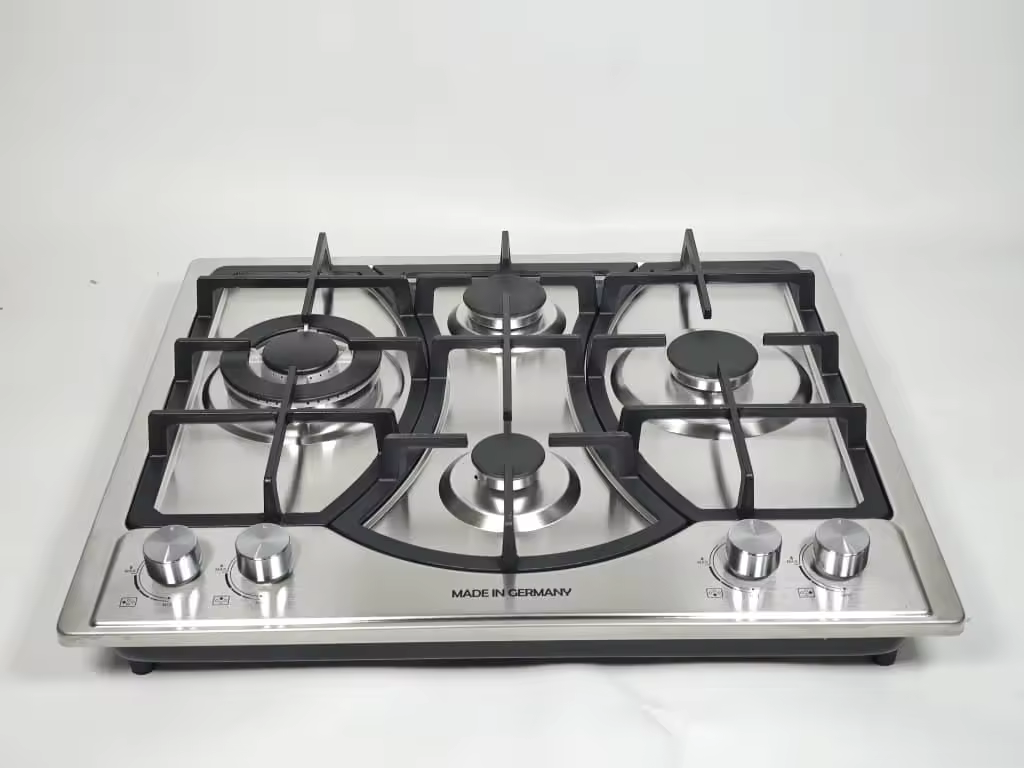
Commercial outfitting presents distinct demands. Residential hobs cook meals for an hour or two daily. A catering equipment stainless steel gas hob must survive punishing, non-stop shifts. Equipment failure in a restaurant halts revenue. You cannot evaluate commercial units using household metrics. We must assess load-bearing strength, heat dissipation, and cleaning efficiency.
Heavy stockpots crush flimsy components. You must analyze the pan support materials carefully. Heavy-duty cast iron grates are strictly non-negotiable for commercial pots. They distribute weight evenly across the chassis. Enamel-coated steel grates look similar at a glance. However, they flex, chip, and degrade quickly under heavy loads. Check the grate footing as well. Rubberized feet must be heat-resistant to prevent the grates from sliding during vigorous cooking.
Thermal management defines a true commercial unit. How well does the chassis dissipate heat during eight or more hours of continuous operation? Heat travels downward from the burners. Without proper internal shielding, this heat damages the gas valves and ignition wiring. We look for internal heat deflectors. We also verify the physical distance between the burner housing and the front control knobs. Knobs should never become too hot to touch during peak service.
Operational friction costs money in commercial kitchens. Smart design features reduce this friction significantly. Seamless stamping eliminates sharp corners and crevices. Grease cannot pool in hidden joints. Deep spill trays catch large liquid boilovers. Removable burner caps allow staff to scrub carbon deposits quickly. If maintenance takes too long, staff will skip it. Poor hygiene then leads to clogged injectors and uneven flames.
Buying off-the-shelf models limits your brand potential. Structuring a custom stainless steel gas hob allows you to cater to specific local preferences. It guides buyers through white-labeling without incurring bloated tooling costs. You can leverage existing factory molds while customizing the crucial functional parts. This strategy keeps unit economics favorable.
Different regions rely on different fuel sources. The engineering requirements for switching between LPG (Liquid Petroleum Gas) and NG (Natural Gas) are precise. LPG operates at a higher pressure than NG. You must specify the exact injector sizing for your target country. Valve calibration also requires attention. A valve calibrated for NG will produce dangerously high flames if hooked up to LPG. Ensure the manufacturer provides dedicated conversion kits or pre-calibrates the units prior to shipping.
Minor adjustments yield significant brand differentiation. Consider your options carefully.
Never sign off on mass production without validating a physical sample. You must know what to expect during this phase. Implement these tests immediately:
These validation steps protect your investment before the factory begins tooling for your bulk run.
Product specifications only tell half the story. You must move beyond the spec sheet to assess operational reliability. A brilliant sample means nothing if the factory cannot scale it. Vetting a stainless steel gas hob supplier involves checking their risk profile, quality control limits, and regional certifications.
Many trading companies pose as direct manufacturers. You must verify a factory’s true capacity. Look for in-house metal stamping machines. In-house stamping ensures they control panel thickness and chassis tolerances. Automated assembly lines indicate a mature manufacturing process. They reduce human error during gas valve installation. Furthermore, check if they operate internal gas testing chambers. Factories lacking these chambers often skip vital safety tests during peak production months.
Demand transparency on factory defect rates. Do not accept vague assurances of quality. Ask for their specific Standard Operating Procedures (SOP).
Strict QC protocols prevent dangerous units from entering your shipping containers.
Regional compliance dictates market entry. You must verify factory audits alongside product-specific certifications. Ask for their ISO 9001 quality management certificates. Ensure they hold current CE marks for European markets. If importing to North America, they must provide ETL or CSA certifications. Cross-reference these documents with the issuing bodies. Forged certificates remain a persistent issue in overseas procurement. Genuine documentation protects you from customs seizures and liability lawsuits.
Logistical preparations secure your investment prior to bulk shipment. Even excellent factories experience variations between batches. You need operational steps to enforce consistency. Managing lead times, securing spare parts, and establishing maintenance routines define a successful procurement cycle.
Establish a strict testing protocol for your pre-production sample. We call this the "Golden Sample." Do not accept aesthetic approximations. The sample must match mass production tooling exactly. Keep this sample in your possession. When the final bulk order arrives, compare the batch units directly against the Golden Sample. Check panel thickness, grate weight, and flame stability. If the factory swapped 304 steel for 201 steel during mass production, the Golden Sample provides your proof.
Commercial appliances endure rough handling. Parts will inevitably break. You must negotiate Free-of-Charge (FOC) spare parts during the initial contract phase. Factories typically offer 1-2% FOC parts based on total order volume. Prioritize easily worn components. Request extra control knobs, piezo igniters, and thermocouples. Having these parts on hand supports your local warranty claims. It prevents angry customers from waiting weeks for international replacements.
After-sales support keeps your brand reputable. B2B buyers should request the manufacturer's preventative maintenance protocols. Pass these detailed checklists on to your end-users. Daily cleaning of burner caps prevents carbon buildup. Monthly checks of gas hoses prevent dangerous leaks. Proper maintenance improves the product lifespan drastically. Educating your buyers reduces frivolous warranty claims and elevates your standing as a professional distributor.
Sourcing a reliable gas hob at scale demands rigorous attention to detail. You must align material specifications with your market requirements. You must ensure regional compliance through verifiable certifications. Furthermore, you must deeply assess supplier manufacturing capabilities to avoid delays and defects. Relying on glossy catalogs invites operational disaster.
Take actionable steps today. Consolidate your technical requirements into a highly structured Request for Quotation (RFQ). Specify your desired steel grade, burner architecture, and safety features clearly. Initiate a pilot sample order first. This tests both product performance and supplier communication under pressure. Proactive vetting safeguards your supply chain and protects your long-term brand equity.
A: The standard MOQ typically ranges from 200 to 500 units per model. Many factories prefer orders matching a 1x20ft shipping container to optimize loading. If your custom design requires entirely new tooling or molds, suppliers often demand higher MOQs to offset their initial engineering costs.
A: You can use chemical testing kits to detect nickel and manganese levels instantly. For bulk orders, request official material composition certificates from the factory. To ensure complete accuracy, send a random production unit to a third-party laboratory for independent metallurgical verification.
A: Standard off-the-shelf models usually require a 30 to 45-day lead time. If you order new OEM designs involving custom molds, branding, or specific localized certifications, expect timelines to stretch to 60 days or more. Always factor in additional transit time for ocean freight.
A: An FFD automatically cuts off the gas supply if the flame accidentally extinguishes. Unburnt gas leakage in enclosed commercial spaces creates extreme explosion and suffocation hazards. Most global safety authorities mandate FFDs to mitigate liability risks and protect kitchen staff from catastrophic accidents.

